

By JP Snow, Principal & Founder at Customer Catalytics, June 20, 2025
This is part 2 of my series on applying generative AI to customer analytics. Drawing on 18 months of hands-on client work, I’m sharing proven approaches that bridge AI capabilities with business growth. Want more strategic insights on leveraging AI? Subscribe now and join leaders turning analytical disruption into opportunity.
From Weeks to 90 Minutes: A Real-World Case Study
If you’re still doing analytics the old-fashioned way – and by old-fashioned, I mean circa 2023 – you’re wasting time and resources, and missing opportunities. The acceleration in AI-powered analysis isn’t coming; it’s here.
To prove the point, I built a test case based on helping aspiring snowbirds find optimal coastal markets for a second home. The specific decision factors I prompted were “weather (winter temperature), culture, cost, regional growth (to drive appreciation) and risk.” This example has all the messy elements that make real customer analytics hard: mixed-quality data from different sources, volumes too big for spreadsheets, and multiple ways to solve the same strategic question.
I rolled up my practitioner sleeves for this one, aiming to find a data-driven answer as efficiently as possible. I used Claude, which is my generative AI assistant of choice. It took me just 90 minutes to finish a project that would have taken weeks or longer just a few years ago. For a typical analytics team, that’s the difference between a $1,000 project and a $20,000 one, or in other terms, the difference between answering one strategic question per month versus twenty.
The Pre-Generative AI Era (Before 2022)
For the past few decades, SAS, Python and R have dominated exploratory analytics and modeling, supplemented by a progression of interactive tools, starting with OLAP in the 1990’s and progressing to visual tools like Tableau in recent years. The most productive versions of these solutions still required weeks of researching data sources, downloading them (often for a fee), multiple trial-and-error cycles on quality, and wrestling with mismatched keys across datasets. Once the data was ready, producing analysis required laborious hand-coding to produce and present insights.
First Advancement: Coding Acceleration (2022-2024)
ChatGPT’s release dramatically accelerated analytic coding, taking it from manual to automatic through a combination of guided writing and rapid debugging. Every developer who uses Python, R, SAS or another programming language has benefited from a giant productivity boost. For my test case, Claude generated 400 lines of Python that ran successfully on my first attempt. Here’s a snippet of the program.

This is the type of code your analysts typically spend hours writing and debugging. Programming languages require precise syntax and follow predictable patterns—exactly what AI excels at. That’s why coding was AI’s first major breakthrough in analytics.
Generative AI has made coding exponentially easier, and that was just the beginning.
Direct Data Analysis Capability (Late 2024)
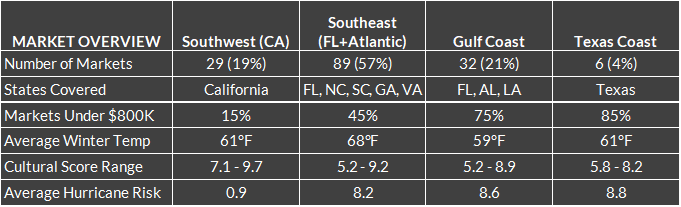
In 2024, the major AI assistants began touting direct analysis capabilities. Users could insert data into a chat and directly prompt for insight. I’ve used this approach myself for several projects in the past year, including this one. Data acquisition remained the fundamental problem, which I solved through another advancement described below. Once I had a data set, Claude was able to produce multiple insights about it, through the same conversational “chats” we’ve quickly come to use daily. Here’s a sample of output selected from over 30 lines of descriptive statistics easily generated from a simple prompt. In addition to the obvious counts and average, Claude independently generated more complex metrics relevant to the 5 value dimensions I provided. Examples included composite indexes and rate of change measures.
Multi-Agent Orchestration (Past Month)
Anthropic’s new multi-agent research system (“Research mode”) is a game changer that arrived just in time for my test case. If you haven’t experienced it yet, try a prompt that requires some strategic planning to acquire and compile information from multiple sources. The system can now parcel out different analytical tasks in real-time as distinct coordinated processes. This advancement is the most powerful AI advancement I’ve seen for accelerating data gathering and prep, which has long been the hard part of most analytics projects. For my test case, I watched in real time as Claude orchestrated 10 separate sub-tasks. It compiled and transformed data from 15 sources, generating a relevant and thorough data set ready for further analysis.
Within San Diego, La Jolla and Pacifici Beach are very different adjacent communities. When I pointed this out, Claude responded by re-summarizing at zip-code level. It proactively chose methods for triangulating to complete missing data and mismatched geographic keys. The overall process wasn’t just faster, it was more thorough, with built-in quality checks and alternative perspectives I would have missed working alone. For analytics teams, this means tackling 20 times more strategic questions per quarter instead of being bottlenecked by data preparation.
We in the analytics field have always found data acquisition the most challenging step. For use cases like mine, multi-agent orchestration means a dramatic leap in time to insight.
Guided Analysis Tools (Recent)
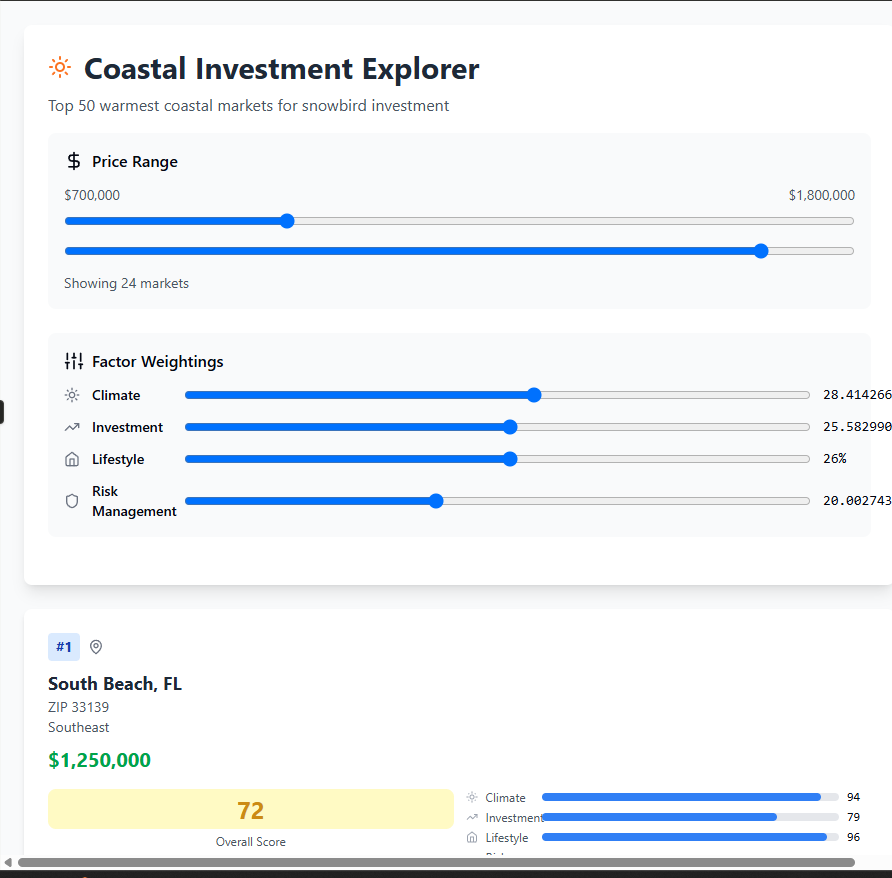
In recent months, I’ve been seeing Claude generate interactive tools, often unprompted. If you haven’t experienced this for yourself, prompt for it. Knowing such a tool would be helpful for my test case, I prompted “Create an interactive tool for helping me explore the top choices based on different weightings. Narrow the field down to the 50 warmest locations as the domain for the tool.” The result was this artifact, displayed directly in the interface next to my chat session. Though the graphics are rudimentary, the sliders work well enough so that any prospective snowbird could see top markets based on their own experimental weightings of real estate, weather and other factors.
Analytics Advisor
I wrote in the first part of this series about AI as Wingman. In this test case, Claude demonstrated multiple ways it has evolved beyond tool to strategic partner, handling tasks that traditionally required human analytical judgment. At several points, it evaluated trade-offs between different analytical approaches and offered recommendations or directly chose which path to take. This informed reasoning contributed to dramatically faster data compilation and much richer insights.
Here’s an example. At one point I noticed that among the top-ranked locations were beach areas I didn’t recognize. Asking why, Claude responded:
- A direct prompt might recommend Myrtle Beach, SC (strong brand, known snowbird destination) while the data shows it scores lower (6.2 cultural score, 58°F winter temp) than the Florida markets identified through analysis.
- This demonstrates the value of data-driven analysis in:
- Uncovering hidden gems
- Avoiding cognitive biases
- Providing reproducible, transparent recommendations
- Providing reproducible, transparent recommendations
This meta-analytical capability – AI evaluating methods and biases – fundamentally changes how we can approach AI-powered analysis.
Key Take-Aways for Analytics Leaders
- Recognize How the Dreaded Data Bottleneck is Getting Solved – Multi-agent orchestration is addressing the greatest historical constraint in analytics. What used to take weeks of manual data gathering, cleaning, and integration now happens in hours with built-in quality checks.
- Understand How AI Can Operate at Meta-Levels – AI assistants can now evaluate different analytical approaches, including their own limitations. This meta-analytical capability transforms AI from a source of suspicion to a thought partner that can recommend and evaluate divergent approaches.
- Realize How AI Enables Practitioners to Shift from “How” to “Why” – Technical execution is increasingly automated. The premium now lies in strategic thinking: defining the right questions, interpreting results, and translating insights into action. The new frontier doesn’t replace analysts; it elevates them from data wranglers to strategic advisors.
- Prepare for Non-Linear Acceleration – These aren’t discrete phases; they’re overlapping signals of continuous acceleration. The pace of advancement is increasing, not stabilizing.
- Appreciate the Implications of Computing Power as the Main Constraint – The main limiter right now is processing capacity. Token limits occasionally required me to narrow datasets, but this constraint is rapidly disappearing.
What This Means for Your Analytics Practice
The snowbird analysis demonstrates how generative AI assistants are fundamentally changing analytical work. We’re experiencing rapid, overlapping advancements that continue to accelerate. The same transformation happening in customer analytics applies whether you’re helping clients choose vacation homes, identifying customer churn patterns, or evaluating market entry strategies.
Organizations still using 2023 methods aren’t just slower; they’re asking fewer and simpler questions, missing insights their AI-enabled competitors find daily. The question isn’t whether AI will transform your analytics practice. It’s whether you’ll lead that transformation or get left behind.
Coming Soon: Why Two AIs Are Better Than One
In Part 3, I’ll share what I’ve learned about orchestrating multiple generative AI tools to create more robust, reliable insights. It’s useful to let one assistant get to know you, while keeping at least one other provider in a more objective, arm’s-length relationship. I’ll also share reasons for using separate models for data creation and data analysis.
I help leaders get faster growth through data and scale. My approach is built on what works: Data Decides. Insights Inform. Moments Matter. Systems Sustain. Talent Transforms.
© 2025 Customer Catalytics. All rights reserved.


