

By JP Snow, Principal & Founder at Customer Catalytics, September 11, 2025
This is part 3 of my series on applying generative AI to customer analytics. Drawing on years of hands-on client work, I’m sharing proven approaches that bridge AI capabilities with business growth. Want more strategic insights on leveraging AI? Subscribe now and join leaders turning analytical disruption into opportunity.
If you’re among those debating which gen AI tool to go with (ChatGPT vs. Claude vs. Gemini), you’re asking the wrong question. The field has quickly moved beyond single-model approaches. You should too, even for everyday business needs.
The latest AI systems automatically coordinate multiple specialized models to tackle complex problems, combining best-of-breed language models with specialized tools for search, analysis, coding, and reasoning. The industry has realized that no single AI excels at everything. The same concept applies to the gen AI tools themselves. Here are three reasons for making a practice of using more than one generative AI tool.
How Smart Leaders Orchestrate Multiple Gen AI Tools
1. Create Familiar and Neutral AI Partners
The tools are getting better at knowing us. ChatGPT and now Claude both remember context across our chats. The tools do let you control what they remember, but these controls keep changing. For example, if you haven’t looked at ChatGPT’s personalization settings recently, take a look at the Personalization tab in settings, and make sure to check out the Manage tab too.

Chatgpt personalization tab
This growing familiarity creates both opportunity and risk. Your AI partner becomes increasingly helpful, anticipating needs and adapting to your style. But sometimes you want an objective, unbiased opinion not shaped by your past preferences.
The solution is to use separate tools based on circumstance. My own approach has been to make Claude my trusted partner, loading it with specific prompts and standing instructions about my preferences and style. I then keep ChatGPT as neutral as possible, using it primarily for functional tasks like Excel formulas and quick queries.
Consider how this same bifurcation principle applies specifically to analytics. We all have biases for certain techniques. By using multiple gen AI tools in the course of analysis, you can choose when to get the methodology you’re most familiar with, supplemented by alternatives you might not have considered.
A year ago I tested the latest data analysis capabilities of ChatGPT and Claude in an AI face-off. ChatGPT delivered superior visualizations and faster execution. Claude provided deeper contextual analysis and better data validation. Using both gave me their combined strengths. For the final output, I even combined them directly by having Claude hand-off its conclusions to ChatGPT for the final output. Different gen AI tools excel at different tasks. Rather than hoping one tool handles everything well, we should always be matching tools to their proven (and evolving) strengths.
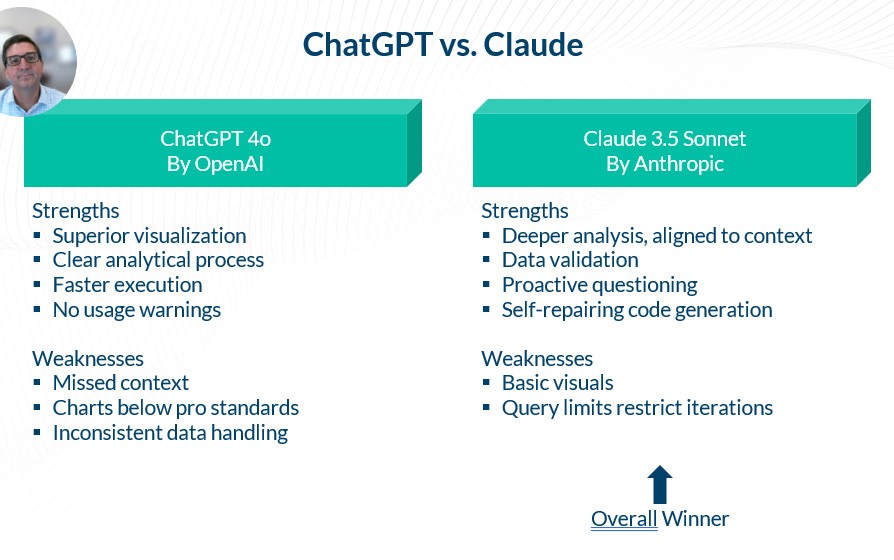
From AI Face-Off: Claude vs. ChatGPT, JP Snow, Nov. 2024
In my own work more recently, I’ve found Claude wins at data analysis, deep research, and writing to match a specific tone and voice. ChatGPT is better at writing code and creating visuals, plus it has fewer time-outs and access issues. My current workflow uses ChatGPT primarily for search and functional tasks, while I turn to Claude for complex reasoning and nuanced business analysis.
This isn’t about tool loyalty. It’s about tactical efficiency. Each tool has evolved distinct capabilities. Acknowledging these differences and leveraging them strategically multiplies your analytical power.
3. Cross-Validate through AI Independence
Using different tools for different parts of a project provides independent validation and verification. You can transform, train and explore data in one tool, then test the model and verify discoveries with a different one, establishing independent cross-checking.
A recent case study from my own company’s work involves a project where we’re generating simulated data to develop a model. We’ll use a different AI system when we’re ready to test the methods and results. Such independent testing often reveals blind spots or alternative interpretations that single-tool analysis might miss. It minimizes both human and machine sources of bias, which proves especially valuable when decision stakes are high.
Conclusions
Using multiple generative AI tools offers advantages of neutrality, strength and independence. When we learn how to combine tools well, we gain analytic power and reduce multiple forms of bias. The future belongs to those who can conduct an AI symphony, not just play a single instrument.
Takeaways to Catalyze Your Success
- Memory means familiarity – AI tools now learn your preferences over time, making routine work faster while potentially reinforcing your analytical blind spots
- Specialization beats generalization – Different AI systems have developed distinct strengths; match tools to tasks rather than forcing one to handle everything
- Independence prevents tunnel vision – Using separate AI systems for different project phases reveals insights single-tool approaches miss
- Capabilities keep accelerating – Stay current with new features across multiple platforms rather than mastering just one tool
- Orchestration skills matter – Success requires managing multiple AI relationships strategically, not becoming expert with any single tool
Coming Soon: Making Sense of Your Customers
In Part 4, I’ll explore generative AI’s multi-faceted impact on customer segmentation. Whether you’re grasping common personas in a new industry, seeking faster speed to market, or looking to translate statistical clusters into meaningful groups, generative AI combines quantitative and qualitative capabilities in ways traditional methods can’t match. I’ll share how this combination transforms segmentation from a statistical exercise into actionable customer insight that teams actually use.
I help leaders get faster growth through data and scale. My approach is built on what works: Data Decides. Insights Inform. Moments Matter. Systems Sustain. Talent Transforms.
🔹 Don’t Miss Out: Get future insights by clicking the +Subscribe button at the top of this article.
© 2025 Customer Catalytics. All rights reserved.


