
Navigate AI’s Customer Impact with One Key Question
By JP Snow, Founder & Principal at Customer Catalytics, 2024
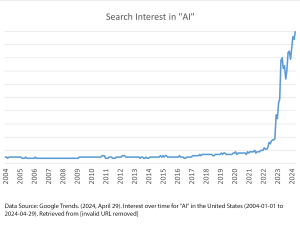
If anything is outpacing advancements in artificial intelligence right now, it’s the proliferation of references to it in media, blog posts, company news, and product features. Searching “AI” on Google Trends produces a classic hockey stick curve that turns sharply upward starting in Q4 2022. Most corporations are now referencing AI in their earnings calls. AI features abound in everything from household gadgets to restaurant operations. Investor relations staff and marketers face growing pressure to show their firm is keeping up. For those of us who work in analytics or product development, we’re feeling even more “AInxiety,” not just to talk about it, but to understand the latest algorithms and implement them.
It’s not all hype. AI advancements have saved lives and boosted our economy. What started that exponential pop in late 2022 was a revolution in generative AI, beginning with Open AI’s release of ChatGPT. Large language models were suddenly powerful enough to interpret our collective web of knowledge. Competitive pressures drove other tech giants to release their own models and heavily fund additional development. Thousands of companies began mobilizing around new services and product features. We started getting information through prompts instead of searches. Artificial intelligence, a technology previously constrained to highly specialized fields, became available for general use through any screen. Using AI in medical practice still requires an MD, but anyone can use ChatGPT to proofread a paper or create a fun photo mash-up. With access to such powerful techniques now universal, any product or process without it risks appearing obsolete. If it’s not all hype, there is plenty of it, which makes it hard to discern where AI is having the most real benefit for us and our customers. How do we navigate artificial intelligence as a new technology and the stakeholder expectations that come with it?
Reframe by Asking: What Gets Automated?
Artificial intelligence and AI rapidly became the ubiquitous terms for describing any applications of large language models and machine learning. The sci-fi future is here, and AI is how a company signals they have it. Unfortunately, the dominant term is also imprecise. Artificial intelligence covers a huge span of techniques. Basic regression is a form of machine learning, which is considered a subset of artificial intelligence. Consequently, artificial intelligence may mean a cutting-edge algorithm, but it doesn’t have to. Seeking a better term, my first impulse was to think in terms of automated intelligence, automated decisions, or more simply, automation. Automation is equally loaded as and intertwined with artificial intelligence. Technically speaking, AI doesn’t automate anything until it’s implemented. Its role is to enable automation by providing increasingly advanced decision logic. For those of us focused on outcomes, we can consider the whole combination of AI’s intelligence and how it gets applied by focusing on the resulting decisions and actions. We can ask: “What Gets Automated?” This approach is pragmatic, more user-friendly and it projects our thinking into the potential ramifications. More specifically, this single question uncovers the three things we as AI consumers are most interested in: (1) the specific capability and its power, (2) the benefit to the user, and (3) the risks. Thinking about AI in terms of what automation it enables will help us all see this rapidly changing technology and its effects more clearly, cutting through the hype and reducing our collective anxiety.
You Can’t See a Model, But You Can See Its Effects
Though no bot has yet passed the Turing Test, the most advanced generative AI models are beginning to resemble human intelligence. Generative AI can now be conversational, mimic lateral thinking, and even surprise us. It’s through those experiences that we begin to understand what the latest algorithms are capable of. For most of us, petaflops, training parameters and other model details are less useful than knowing how many extra pages of text can be processed and how responses to prompts are more relevant. For me personally, the most powerful advancement I’ve seen this year was when Gemini gained the ability to connect to a Gmail inbox. Catching up on a backlog of messages was suddenly easier and faster. Telling others that Gmail now “has AI” could mean a range of things. It’s far more useful if I tell them that Gemini now connects to Gmail and what gets automated is the ability to summarize unread messages, by category. Asking “What Gets Automated?” demands specificity about the capabilities, their power, and how useful they are. The question also prompts us to think ahead about the potential impacts, good and bad. Artificial Intelligence is a concept. It’s a technique or a category of them. It’s a noun. Automate is verb. It’s something that you do, resulting in effects on something else. Only when advancements in AI are described in terms of automation does a model’s true novelty and power become clear.
Consumers Benefit Primarily Through More Accuracy and Reduced Effort
Has AI FOMO led you to a purchase that didn’t deliver what you expected? My own recent example involved graphic design software. Based on product descriptions, I expected automated layout help. What I got was writing features, which I don’t use because I’m committed to authenticity. As for proofreading help, I already get that from Claude. Asking “What Gets Automated?” would have saved me. Better yet, the product marketer could have made those details clear. The realized benefit to the consumer comes from some improvement in their experience, typically through improved accuracy or reduced effort, directly or through a reduction in steps or decision fatigue. The comprehensive automation question also captures implementation and usability factors that affect an AI model’s utility after it passes model governance.
Whether we’re the product manager or the consumer, knowing specifically what a new AI technology enables forces clarity in our thinking about the realized benefits. In a quick search for household appliances claiming AI, I found air fryers, grills, vacuum cleaners and refrigerators. Reading past the product headlines revealed a wide range of ways AI was doing something of value for the user. Robot vacuums can map your floorplan and adjust cleaning cycles adaptively based on your household. One of the AI-enabled vacuum cleaners I found was a stick-vac. What gets automated is brush height adjustment and battery life optimization. Though those benefits aren’t quite as sweeping as what the robot vacs provide, I credit the product description for clarity about the benefits. That product even showed certification from Underwriters Laboratory verifying AI reproducibility.
Understanding Incremental Automation Reveals Risks and Remediation
Finally, the automation question helps us address risk by revealing what decisions and actions will happen without human involvement. An algorithm that identifies cancerous tissue can be leveraged in several ways, with varying degrees of risk to the patient. It could automate the doctor’s prep the day before, their focus during the procedure, their validation that the procedure is complete, or the entire operation from beginning to end. As patients, we would expect commensurate levels of confidence and safeguards for each of these scenarios. Rising fears about the dangers of AI come from legitimate concern that bad decisions could be made at an unrecoverable scale. Automation involves process. Process involves steps, which can include checking mechanisms and other guardrails. Understanding the changes to steps is the right framing to identify and address the risks. “What Gets Automated?” reveals those changes.
Terminology Will Evolve with the Market
Artificial intelligence, AI, generative AI, ChatGPT and other terms are being used interchangeably. Among these, generative AI is an example where using a more specific term adds clarity about the techniques involved and their benefits. In the absence of a clearer lexicon, I’ve proposed “What Gets Automated?” as a direct way to discern our way through ambiguity and hype. Automated intelligence and automation are also potentially useful terms. What matters most is that product developers, marketers and data scientists find better ways to clarify value propositions for their customers.
We don’t know how these terms will evolve in the coming years. History suggests they’ll either change or fall out of use completely. Google Trends shows that over the past two decades machine learning has maintained a continuous rise, big data is falling out of favor and neural network shows renewed momentum. As a descriptor, artificial conveys human progress when used with limbs but more negative sentiment when used before plants or sweetener. As for automation, its use has been steadier. Long associated with “home automation,” automation’s top “related query” recently shifted to a question: “what is automation?” Perhaps I’m not the only one thinking this way.
Insights to Catalyze Your Success
- To understand AI and explain it to others, ask “What gets automated?”
- Customers want realized benefits, not hype, which they ultimately see through
- Identify AI’s risks and address them by evaluating where and how it’s being inserted into process steps
© 2025 Customer Catalytics. All rights reserved.


