

By JP Snow, Principal & Founder at Customer Catalytics, November 12, 2025
This is part 4 of my series on applying generative AI to customer analytics. Drawing on years of hands-on client work, I’m sharing proven approaches that bridge AI capabilities with business growth. Want more strategic insights on leveraging AI? Subscribe now and join leaders turning analytical disruption into opportunity.
In my consulting engagements, I’ve used generative AI for market sizing, business modeling, product naming, and growth forecasting. I can’t think of an analytics application more naturally suited to AI than customer segmentation.
Segmentation requires both quantitative rigor and creative interpretation. Large language models are great at both. Segmentation blends statistical analysis with human insight, and pattern recognition with strategic storytelling. With human-only approaches, this dual nature requires time, unique expertise and heavy mental load. Generative AI tools contribute advantages of speed, objectivity and comprehensiveness.
Three Ways AI Transforms Segmentation
1. Instant Industry Personas
Scenario: Your credit card company’s strategy team identifies a revenue opportunity: referral offerings for niche interests, starting with travel. Specifically, you’re exploring matchmaking between travelers and local tour guides. The challenge: your team has only personal anecdotes, not systematic customer insights about this market.
Here’s my prompt to Claude (Opus 4 model) and the full result I received.
Our credit card company is developing a new offer to help travelers find tour guides when visiting popular cities. To help us refine our strategy, provide 3-5 archetypes of travelers who might engage a personalized tour. Provide a label plus at most two lines describing the mindset and primary need.
- Premium Experience Collector: High-spending cardholder seeking exclusive access and VIP treatment. Needs white-glove service that reflects their status and maximizes rewards.
- First-Timer Abroad: Nervous but excited traveler using points for their dream trip. Needs trusted, patient guide to build confidence and avoid tourist traps.
- Weekend Warrior: Frequent business traveler maximizing personal time in client cities. Needs efficient, flexible tours that work around unpredictable schedules.
- Empty Nest Explorer: Newly retired couple rediscovering travel without kids. Needs comfortable pacing with cultural depth they couldn’t enjoy before.
- Bleisure Optimizer: Remote worker extending business trips into working vacations. Needs morning/evening tour options that fit around virtual meetings.
While less rigorous than formal research, these 30-second personas provide enough insight to evaluate appeal, pricing, and go-to-market strategy. Your team could assess a dozen concepts in one session, overcoming personal biases and identifying which ideas merit deeper research investment.
2. Making Math Meaningful
If you’ve ever done cluster analysis, you know the output consists of abstract clusters that need interpretation. Working with a large nonprofit last year, I used Python to generate four member segments using k-means clustering. To make the resulting segments actionable, I prompted Claude to “create a narrative, including label options, key traits and top opportunities” for each cluster. The AI analyzed distinguishing features, such as one cluster’s high engagement rates versus another’s low participation among subscribed members. It also generated meaningful names that leadership could immediately relate to and see themselves using. Here’s a sample.
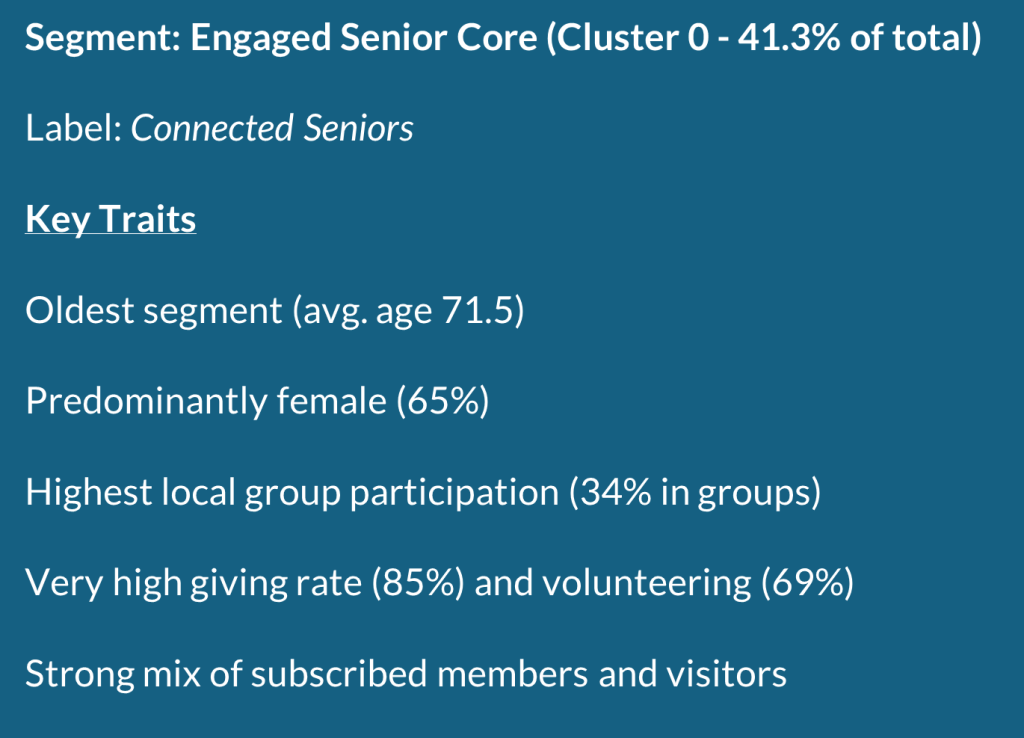
I’m now working with this organization to build out their CRM, which will mean the next round of segmentation will use many more data points. Statistical methods can help filter which dimensions have the most weight. Because LLMs also consider language, they mimic the way humans consider both quantitative and qualitative nuances in the data. They do so faster and without the limitations where a human researcher becomes overwhelmed with the number of dimensions to think about.
3. Finding Business Leverage
Well-named, optimally calculated segments only matter if they drive action. The most distinct traits aren’t always the most actionably distinct. For the same nonprofit project, I prompted further to identify strategic opportunities across segments. It spotted patterns like age-based engagement gaps and distinct giving behaviors, then translated these into potential initiatives. Here are some select examples:
Key Findings
- Clear age stratification across segments
- Strong correlation between age and involvement
- Distinct giving patterns between engaged and peripheral segments
- Opportunity gap in middle-age engagement
Strategic Opportunities
- Engagement Pathway Development – Create clear steps from visitor to active member
- Donor Development – Create segment-specific giving campaigns
- Digital Expansion – Target digital adoption in under-performing segments
Conclusions and the Changing Landscape
What makes AI transformative for segmentation isn’t just the dramatic improvement in speed to market but also how it fundamentally changes what’s possible. With traditional approaches, you hit cognitive limits. Humans can process maybe a dozen dimensions before losing the thread. AI grasps unlimited dimensions simultaneously, weighing quantitative patterns and qualitative nuances equally, then projecting both into strategic applications. The impact isn’t just faster. It’s also more objective and more complete.
Takeaways to Catalyze Your Success
- Speed enables iteration – Test multiple segmentation approaches in the time one iteration used to take. Real learning comes from trying variations.
- Objectivity beats intuition – AI lacks your industry biases, revealing segments you’d never consider but customers actually represent.
- Start with strategy – Don’t segment because you can. Define the business decision first, then let AI help find the customer patterns that inform it.
- Validation still required – AI-generated segments need real-world testing. But now you can test 10 approaches for the cost of developing one traditionally.
Coming Soon: AI as Your Strategic Planning Partner
In Part 5, I’ll explore how AI transforms strategic planning through assumption testing, stakeholder simulation, and industry synthesis.
I help leaders get faster growth through data and scale. My approach is built on what works: Data Decides. Insights Inform. Moments Matter. Systems Sustain. Talent Transforms.
Don’t Miss Out: Get future insights by clicking the +Subscribe button at the top of this article in my LinkedIn
© 2025 Customer Catalytics. All rights reserved.


