
By JP Snow, Principal & Founder at Customer Catalytics, May 28, 2026
This edition is part of my Pragmatic AI series. Drawing on years of hands-on client work, I’m sharing proven approaches that bridge AI capabilities with business growth. Want more strategic insights on leveraging AI? Subscribe now and join leaders turning analytical disruption into opportunity.
For background, Solo Agora is an AI-based platform I recently launched. It’s designed to promote critical thinking and civil discourse, what I call “reasoning fitness,” by turning AI on the problems it’s creating. Solo Agora is a suite of chatbot agents, all wrapped in a branded experience complete with access management and payment features. It’s free to try at soloagora.com, and I’ve written more about the origins at soloagora.substack.com. This article is about what I as an analytics and CX practitioner learned while developing this product.
For perspective, I built the MVP in a day and went from concept to launch in less than a week. Using what I learned and am sharing here, you might be able to go even faster.
The Technology Lens
Solo Agora is built on the Pickaxe platform. I’ve been watching Pickaxe since 2024 when they were offering a beta project. Their development studio now offers a full range of options to build and deploy AI agents, on websites or embedded into proprietary systems. Their capabilities make it ultra simple for anyone with an AI concept to define, build, deploy and monetize AI. I was able to create an MVP of my concept in about a day’s work. I estimate I’ve spent another two days total refining things like the brand colors and the verbiage used to guide users. It would take someone without my background longer, but I feel confident that a resourceful person could launch a basic chatbot-type agent in less than two weeks of focused effort. (Helping founders do this is part of my consulting practice. If you want that outcome but don’t have the time, let’s talk.)
The Analytics Lens
As an analytics practitioner, there were two areas I had to address in launching this concept.
The one that will be of interest to most people here is figuring out which AI model to use. The Pickaxe platform allows you to select from any of the most popular offerings, with options to filter and evaluate the trade-offs in speed, depth, and cost (see screen shot below). Their interface also shows an ongoing tracker, so you know how much you’re spending on AI tokens. The five agents I launched ranged significantly in how much work the LLMs have to do. The ability to tune each agent separately is critical for getting the cost structure and pricing right. This direct access to the AI LLMs is a big improvement over Pickaxe’s original version, which required users to set up their own API keys and payments with each provider separately.
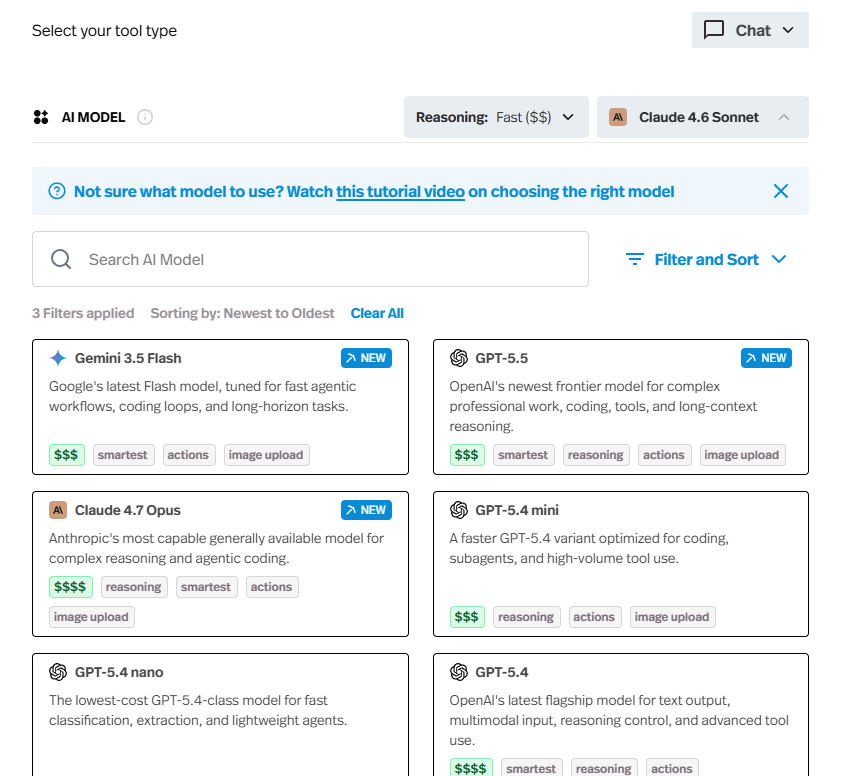
Pickaxe model selection interface, from screenshot taken 5/27/26, used with permission
The other data and analytics decision I had to make was how to manage user data. I started with a firm boundary of never selling users’ information. I did enable the ability for me to see the conversations, mainly because it’s the easiest way to know how people are using the system. Also, a system structured for open dialogue and hypothetical situations leaves lots of outs where someone can enter whatever they want without expecting anyone is attributing that to them.
The Customer Experience Lens
Pickaxe provides the underlying technology, but it’s still up to each product developer to determine the exact experience they want to offer. That begins with deciding whether it’s a stand-alone web portal or a technology embedded in some system of their own. I chose the former. I bought the soloagora.com domain name separately. Mapping it to my Pickaxe workspace involved the easiest experience I’ve ever had adjusting DNS settings. My project lends itself to a chat format, and I elected to build different agents with different personalities and goals rather than having one general agent that tries to do everything. That design decision means users are guided to adopt a specific mindset focused on one reasoning muscle at a time. It was also driven by the need to select which engine to use behind the scenes to right-size the economics.
A key part of my underlying concept is that, while you could replicate what any of the agents provide directly within ChatGPT, my system provides a curated experience with guardrails that keep you on task. For example, Hone, the agent that provides a Socratic question experience, strictly enforces that it won’t answer questions for you. If you ask it a question, it will suggest that you go do the research yourself, then come back. Limiting the options is a core philosophy inherent to modern UX design. Wrapping the latest generative AI tools into a curated experience enables product developers to serve each use case with an intentional combination of training wheels and guardrails.
The Business Strategy Lens
In a world where everything is possible, it becomes more important than ever to remember what you’ve actually set out to do and what types of customers you’re aiming to create. I have to confess that this whole project was an accident. I had selected Pickaxe for an entirely different endeavor and then looked for a simpler use case to test its capabilities. I’d had this recurring thought that we should be using AI to refine our thinking rather than replace it. Within a day, I had gone from a trial experiment with the platform to realizing I had a product to launch. I’m now treating it as a distinct project within the portfolio of my Customer Catalytics business. Though it’s still an experiment, it’s become a serious one now with subscribed, paying users on the platform.
Conclusion
We’ve entered an era where the barriers to building and launching are nearly gone. The new competitive advantage is the ability to build the right thing, for the right customer, with the right economics. Solo Agora took a day. The thinking behind it took years to develop. We all have great ideas the world needs. Now, more than ever, you can bring yours to life.
Takeaways to Catalyze Your Success
Speed to market has never been faster — The tools to define, build, deploy and monetize an AI product are available today. A resourceful person with a clear concept can go from idea to MVP in days, not months.
Match the engine to the economics — Don’t default to the most powerful model for every use case. Evaluate engine options against the depth each task actually requires.
Curate the experience through guardrails and guidance — The platform is the starting point. The decisions about agent personalities, constraints and user flow are what make it a product worth coming back to.
Anchor your strategy to the type of customer you seek to create — In a world where everything is possible to build, the discipline is knowing what to build and for whom. Start with the customer need, not the technology.
It’s Your Turn
Have you built anything with an AI platform, or thought about it? I’d like to hear about it. Maybe I can help. For more practical perspectives on AI, customer strategy and growth, subscribe to the Catalytic Edge at customercatalytics.com/connect — it’s where I share insights first.
I help leaders get faster growth through data and scale. My approach is built on what works: Data Decides. Insights Inform. Moments Matter. Systems Sustain. Talent Transforms.
This article is provided by Customer Catalytics, a customer analytics and strategy consulting firm. We have decades of experience at driving customer growth and retention through insight, automation and leadership. For a complimentary consultation focused on your company’s growth, schedule an introductory meeting at www.customercatalytics.com/connect.
© 2026 Customer Catalytics. All rights reserved.


